How to License IBM InfoSphere Data Replication (CDC Replication) in Open Systems (Windows, Linux, Unix)
|
IBM LICENSING
Authors: Uttam PANDA and Louis VALLIEZ |
|
Link to publication: https://omtco.eu/publications/how-to-license-ibm-infosphere-data-replication-cdc-replication-in-open-systems-windows-linux-unix
Download PDF of this document: https://omtco.eu/publications/How-to-License-IBM-Infosphere-Data-Replication-CDC-Replication-in-Open-Systems-Windows-Linux-Unix.pdf
Download sources used in this document: https://omtco.eu/publications/how-to-license-ibm-infosphere-data-replication-cdc-replication-in-open-systems-windows-linux-unix.zip
Date of publication: 20 July 2024.
This documentation is provided by OMTCO, an advisory company registered in Munich, Germany. For more publications, visit https://omtco.eu/publications. Refer to the end of the document for the authors, statement of independence, and disclaimer. For comments or questions, contact us at publication@omtco.eu.
Abstract
This document is intended for IT leaders, software asset managers, and licensing managers interested in IBM data replication. It provides comprehensive guidance on licensing IBM InfoSphere Data Replication (CDC Replication) software, covering both IBM InfoSphere Data Replication (IIDR) and IBM Data Replication (IDR) licenses. It includes typical data replication architectures, in-depth IBM licensing analysis, and cost calculations. A detailed break-even analysis and optimization strategies help licensing managers make informed, compliant, and cost-effective decisions.
Background
IBM InfoSphere Data Replication (CDC Replication) software has emerged as a preferred technical solution for data replication, offering benefits such as continuous data availability, integration with data warehousing, and zero-downtime database upgrades. Licensing IBM data replication in open systems presents technical and licensing challenges and opportunities.
Licensing managers face numerous challenges. They must understand the technical aspects of the data replication architecture, identify software components and recognize source and target datastores. Additionally, they must comprehend IBM licensing, learn how to calculate license consumption, and select the appropriate license, whether IBM InfoSphere Data Replication (IIDR) or IBM Data Replication (IDR). Achieving this understanding of data replication architecture, IBM licensing, and cost mechanisms helps licensing managers maintain compliance while optimizing costs.
Methodology
Only publicly available sources are used for this analysis, such as the IBM price list and IBM licensing documents. All sources are listed at the end of the document.
The analysis follows four steps. First, define the data replication architecture, identify the IIDR software components, source and target datastores. Next, interpret IBM licensing for IIDR and IDR to highlight common terms and differences. Then, conduct a comparative cost analysis for each architecture by applying IIDR and IDR licensing models. Finally, determine a cost optimization strategy by finding the break-even point between IIDR and IDR while ensuring compliance.
Results
The comparative analysis reveals critical differences in licensing, costs, and optimization strategies. This helps managers determine the best licensing option based on their specific architecture.
IIDR and IDR licenses share common terms but differ in license consumption calculation. Neither requires licensing for the Management Console or Access Server. However, they differ for the data replication engine: IIDR requires licenses for both source and target datastores, while IDR requires licenses only for the source datastore.
IDR licenses (€ 215.48 per PVU) are more expensive than IIDR licenses (€ 114.40 per PVU) but require holding fewer licenses. IIDR has a lower unit price but requires licensing more environments. To identify the most cost-effective license and optimize costs, licensing managers can follow this guide: Licensing with IIDR is cheaper if (Target cores ≤ 0.88357 * Source cores); conversely, licensing with IDR is cheaper if (Target cores ≥ 0.88357 * Source cores).
Conclusion
A comparative analysis of IBM InfoSphere Data Replication (IIDR) and IBM Data Replication (IDR) licensing, along with an understanding of the data replication architecture, detailed cost calculations, and break-even analysis, assists licensing managers in comparing costs and optimizing strategies – while ensuring compliance.
This process helps identify opportunities and select the most cost-effective licensing strategy tailored to specific needs, enabling informed, compliant, and economical decisions for IBM data replication environments. Consider reaching out to the software vendor for support or onboarding a licensing expert for advice and guidance.
Content
1. Functional Data Replication
2. IBM [InfoSphere] Data Replication Licenses (IIDR/IDR)
3.1. IIDR/IDR Licenses Compatibility for Data Replication in Open Systems
3.2. IIDR and IDR Licenses as Alternative Licensing – Not Cumulative
3.3. Licensing the IIDR Management Console and IIDR Access Server
3.4. Licensing the CDC Replication Engine with IIDR Licenses
3.5. Licensing the CDC Replication Engine with IDR Licenses
4. Example – One-to-One Data Replication (Architecture 1)
4.1. Licensing with IIDR Licenses
4.2. Licensing with IDR Licenses
5. Example – Multiple-to-Multiple Data Replication (Architecture 2)
5.1. Licensing with IIDR Licenses
5.2. Licensing with IDR Licenses
6. Cost Optimization and Break-Even Analysis
6.1. Break-Even Analysis with Fixed Source Cores
6.2. Break-Even Analysis with Variable Source and Target Sizes
6.3. Guide for Licensing Managers – Identify the Cheaper License
1. Functional Data Replication
This document only considers data replication architectures in open systems (Windows, Linux, Unix): source datastores are replicated to target datastores via IBM replication engines, all deployed in open systems. In other words, data replication from z/OS to z/OS is not considered in this document.
Key components
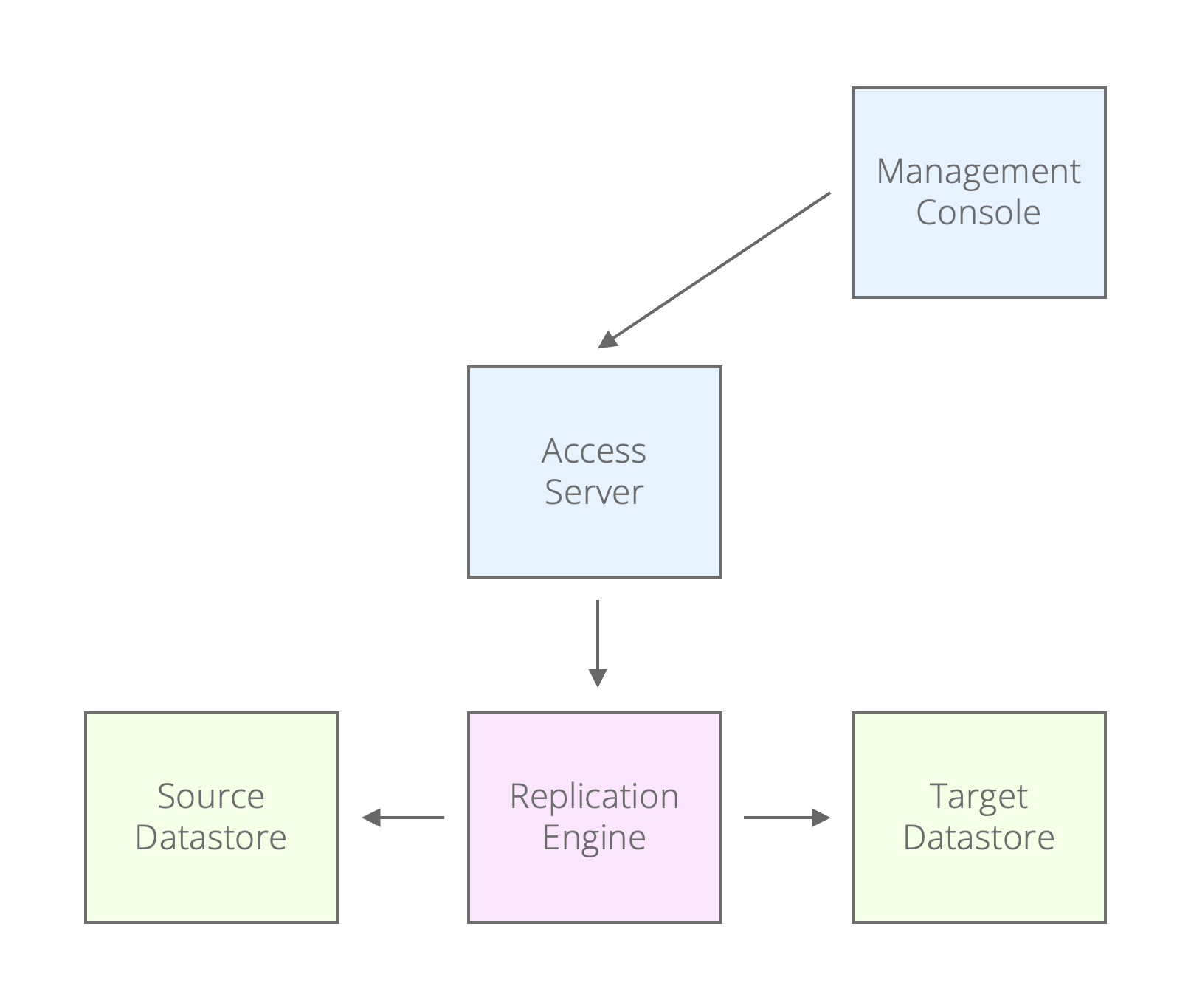
An IBM InfoSphere Data Replication environment in open systems consists of five key components.
The Management Console provides a web interface to configure replication tasks, manage data replication environments, and monitor replication. Software: IBM InfoSphere Data Replication Management Console.
The Access Server provides access to replication services, manages connections, and ensures the performance of data replication. It is accessed through the Management Console. Software: IBM InfoSphere Data Replication Access Server.
The Source Datastore hosts the source data to be replicated to the target datastore – it can be any database (such as IBM DD2, Microsoft SQL Server, Oracle Database) or data repository.
The Target Datastore stores the replicated data – it can be any database, application, or repository.
The Data Replication Engine maintains data consistency between the source and target datastores. It comprises two instances of the replication engine: one instance acts as the Source Capture Engine (SCE), captures changes from the source datastore and pushes data to the target, while the other instance acts as the Target Engine (TE), receives and applies the changes to the target datastore. In a one-tier architecture, the SCE is deployed on the server hosting the source datastore, and the TE on the server hosting the target datastore. In a multi-tier architecture, both instances of the data replication engine are deployed on dedicated servers. An example of a data replication engine is IBM CDC (Change Data Capture) Replication, provided with various database connectors [1].
2. IBM [InfoSphere] Data Replication Licenses (IIDR/IDR)
IBM licenses for data replication in open systems are measured in the IBM metric Processor Value Units (PVUs).
Available licenses and pricing [2]
Two IBM licenses are available: IBM InfoSphere Data Replication (IIDR) and IBM Data Replication (IDR). Both IIDR and IDR licenses [3] are applicable to all environments (production and non-production) with the following unit prices in € per PVU. Note that IDR licenses are approximately twice as expensive as IIDR licenses.
| Part number | License | Acronym | Unit price € (base line) | Unit price € (J-50%) |
| D0L34LL | IBM InfoSphere Data Replication Processor Value Unit (PVU) License + SW Subscription & Support 12 Months | IIDR | 257.07 | 114.40 |
| D1R9KLL | IBM Data Replication Per Processor Value Unit (PVU) License + SW Subscription & Support 12 Months | IDR | 484.23 | 215.48 |
Exhibit 2 – Unit Price of Licenses for All Environments
Non-production environments pricing
For non-production environments, both licenses are available at a ~50% discount.
| Part number | License | Acronym | Unit price € (base line) | Unit price € (J-50%) |
| D1RB0LL | IBM Data Replication for non-production environments Per Processor Value Unit (PVU) License + SW Subscription & Support 12 Months | IDR non-production | 242.71 | 108.00 |
| D0L2NLL | IBM InfoSphere Data Replication for non-production environments Processor Value Unit (PVU) License + SW Subscription & Support 12 Months | IIDR non-production | 127.94 | 56.94 |
Exhibit 3 – Unit Price of Non-Production Licenses
3. Analysis of IBM Licensing
3.1. IIDR/IDR Licenses Compatibility for Data Replication in Open Systems
IIDR and IDR Licenses can be used to license data replication in open systems.
IIDR licenses
According to IIDR licensing:
“Licensee is not authorized to use any of the following components or functions of the Program: CDC for Db2 for z/OS Remote Source, VSAM for z/OS Remote Source“ (ref. L-JZAX-D3RX43-01-10-2023-zz-en, IBM InfoSphere Data Replication v11.4.0.5 GA, published October 17, 2023).
Understanding IBM licensing – This sentence refers to a technical restriction on the data replication engine while using this license (“Licensee is not authorized to use”), the IIDR software (“the Program”), the forbidden components (“CDC for Db2 for z/OS Remote Source, VSAM for z/OS Remote Source”). This means that while using the IIDR license to license a data replication environment, the data replication may not connect to a source on z/OS. In other words, IIDR licenses are restricted to a source/target in open systems (Windows, Linux, Unix).
IDR licenses
IDR licensing has the same restriction as IIDR licensing concerning the remote source [4]:
“Licensee is not authorized to use any of the following components or functions of the Program: CDC for Db2 z/OS Remote Source” (ref. L-FVSX-VJL8JJ-01-10-2023-zz-en, LI IDR v11.4.0.5 GA, published October 17, 2023).”
This means that IDR licenses may be used to license data replication in open systems: the source and target datastores are both in open systems.
3.2. IIDR and IDR Licenses as Alternative Licensing – Not Cumulative
During the installation of the IBM CDC Replication engine, software ID tags are deployed on the replication engine machines. For example, in version 11.4, these tags include:
- IBM_Infosphere_Data_Replication_11.4.0.0.swidtag
- IBM_Data_Replication_11.4.0.0.swidtag
These tags, part of the ISO/IEC 19770-2 standard, provide detailed information about the installed software. Software Asset Management (SAM) tools scan these files to determine which environments need licensing.
Depending on the deployment of data replication software, SAM tools may detect both IIDR and IDR tags on the machine hosting the IIDR Replication Engine. Most SAM tools mistakenly interpret that both IDR and IIDR licenses are required for the IIDR Replication Engine environment. However, the IIDR Replication Engine should not be licensed directly; instead, licensing should apply to the source and target datastores. Additionally, IIDR and IDR are alternative licensing methods, so there is no need for duplicate licensing. As a result, SAM tools commit two mistakes: reporting a duplicate (!) licensing and licensing the wrong (!) environment.
The software ID tags should be manually deployed by IT personnel on the appropriate machines to be licensed: either the IDR tags on the source datastore (if an IDR license is chosen) or the IIDR tags on both the source and target datastores (if an IIDR license is chosen). The original tags deposited during the deployment of the software in the data replication engine environment should then be manually deleted.
3.3. Licensing the IIDR Management Console and IIDR Access Server
IBM licensing for IIDR and IDR licenses instructs not to consider the Management Consoles and Access Servers in the license counting. In other words, they do not consume any IIDR or IDR licenses.
According to IIDR licensing:
“(…) these components are not used to determine the number of entitlements required for the Program. IBM InfoSphere Data Replication Management Console. IBM InfoSphere Data Replication Access Server (…)” (ref. L-JZAX-D3RX43-01-10-2023-zz-en, IBM InfoSphere Data Replication v11.4.0.5 GA, published October 17, 2023).”
Understanding IBM licensing – This sentence refers to software excluded from the license calculation (“these components are not used to determine”), the number of licenses needed (“number of entitlements required”), the CDC Replication engine (“the Program”), the deployments of Management Console and Access Server (“IBM InfoSphere Data Replication Management Console. IBM InfoSphere Data Replication Access Server”). This means that deployments of IIDR Management Console and IIDR Access Server do not need to be licensed; when licensing with IIDR licenses, they do not consume any IIDR licenses.
The same is stated by IDR licensing (ref. L-FVSX-VJL8JJ-01-10-2023-zz-en, LI IDR v11.4.0.5 GA, published October 17, 2023). While licensing with IDR licenses, deployments of IIDR Management Console and IIDR Access Server do not consume any IDR licenses.
3.4. Licensing the CDC Replication Engine with IIDR Licenses
There is a distinction between IIDR and IDR licenses; first consider IIDR licenses.
The CDC Replication engine is not licensed directly
According to IIDR licensing:
“Instead of the entitlements required for the Program directly, Licensee must obtain PVU entitlements for this Program sufficient to cover the processor cores for the systems on which the resources managed or processed by the Program reside.” (ref. L-JZAX-D3RX43-01-10-2023-zz-en, IBM InfoSphere Data Replication v11.4.0.5 GA, published October 17, 2023).”
Understanding IBM licensing – The first part of the sentence refers to the IIDR licenses (“entitlements required”), the CDC Replication engine (“required for the Program”), and the server on which it is deployed (“directly”). This can be interpreted as: Instead of licenses being consumed by the servers on which the CDC Replication engine is deployed. This means that the servers hosting the CDC Replication engine do not need to be directly licensed; they do not consume any IIDR licenses.
How to license the CDC Replication engine
The second part of the sentence clarifies: it refers to the organization (“Licensee”), the IIDR licenses that must be purchased in PVU metric (“PVU entitlements”), the CDC Replication engine (“this Program”), and the servers (“the systems”) on which the source and target datastores are hosted (“the resources managed or processed by the Program reside”). This means that IIDR PVU licenses [5] need to be obtained for the servers that are hosting the source and target datastores.
3.5. Licensing the CDC Replication Engine with IDR Licenses
IDR licensing instructs similarly to IIDR licensing concerning the licensing of the CDC Replication Engine:
“Instead of the entitlements required for the Program directly, Licensee must obtain PVU entitlements for this Program sufficient to cover the processor cores for the systems on which the resources managed or processed by the Program reside.” (ref. L-FVSX-VJL8JJ-01-10-2023-zz-en, LI IDR v11.4.0.5 GA, published October 17, 2023).
However, licensing includes an additional instruction:
“When determining the number of entitlements required for Licensee’s installation or use of the Program, the installation or use of the following Program components are not taken into consideration. (…) Target data resources managed or processed by the Program (…)” (ref. L-FVSX-VJL8JJ-01-10-2023-zz-en, LI IDR v11.4.0.5 GA, published October 17, 2023).
Understanding IBM licensing – That sentence refers to the IDR licenses that must purchase (“number of entitlements”), the CDC Replication engine deployment (“installation or use of the Program”), and the target datastore (“target data resources managed or processed”) connected to the CDC Replication engine (”by the Program “). This means that the servers hosting the target datastores do not need to be licensed; they do not consume any IDR licenses. It may be noted that this instruction contradicts the previous one.
How to interpret the contradiction in IDR licensing?
This contradiction in IDR licensing is obvious: one sentence requires licensing the source and target datastores (“the systems on which the resources managed or processed by the Program reside”), while another sentence states that the target datastores do not need licenses (“(…) are not taken into consideration. (…) Target data resources (…)”). The right provided by the second sentence overrides the obligation required by the first sentence: the target datastores do not need to be licensed.
IBM licensing information is built on standardized text blocks – the first sentence is the same text block inserted in IIDR and IDR licensing. The derogation from licensing provided in IDR licensing is provided as an added paragraph. IBM licensing must always be understood as a whole – any contradictions are interpreted in favor of the customer.
4. Example – One-to-One Data Replication (Architecture 1)
Architecture 1 is data replication in open systems (Windows, Linux, Unix) from one source to one target, in multi-tier architecture: the replication engine, the source datastore, and the target datastore are on different machines.
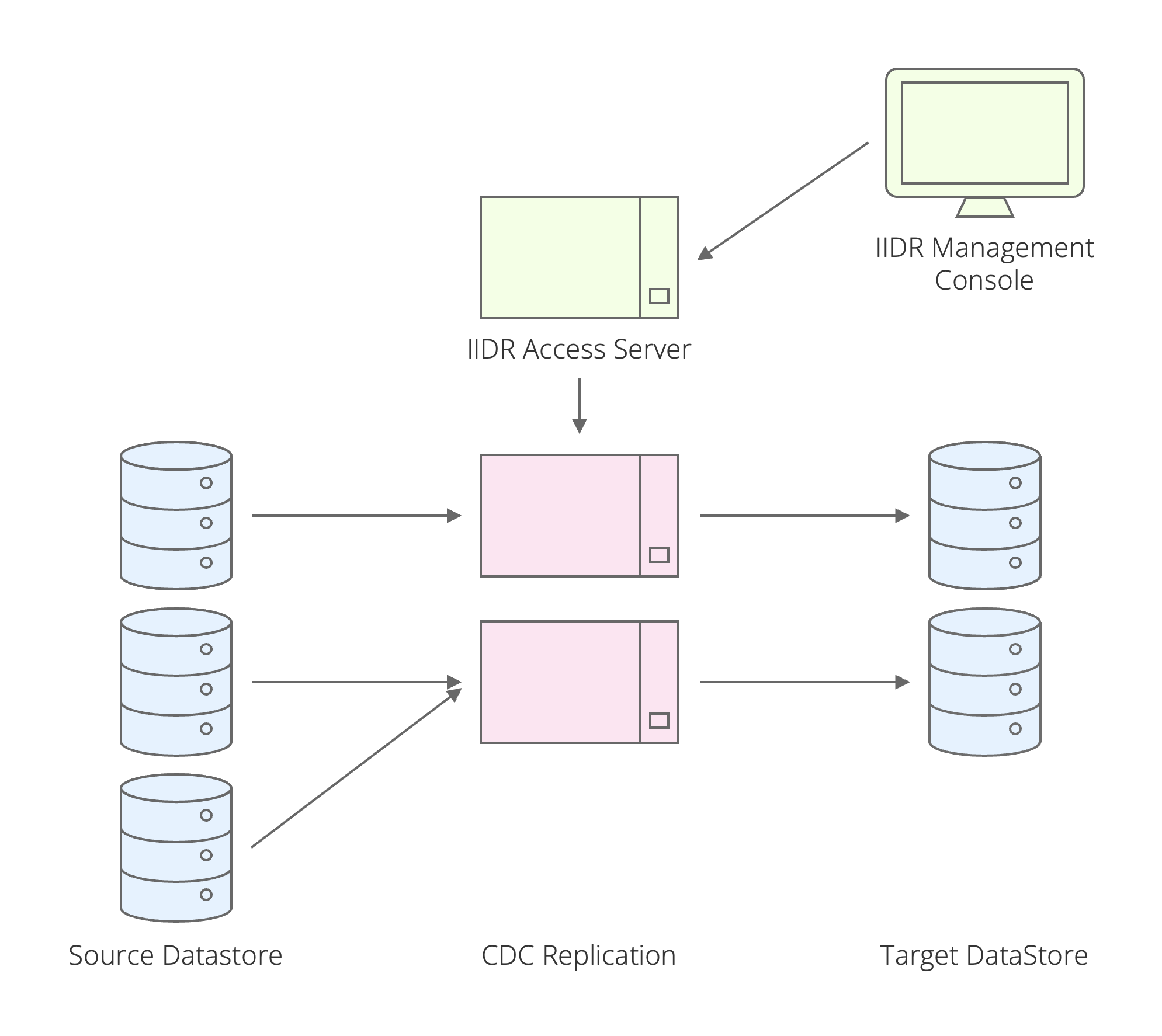
The source datastore is an IBM Db2 Standard on a Linux virtual machine VM1 with 12 cores. The CDC replication engine is deployed on a Linux virtual machine VM2 with 4 cores. The target datastore is a Microsoft SQL Server Enterprise on a physical server PS3 (Windows Server) with 24 cores. The characteristics of the environments with the Access Server and the Management Console are not relevant to the calculation, as these deployments do not consume licenses.
The IBM core factor for Architecture 1 is assumed to be 70 PVU/core to the IBM PVU table (ref. IBM PVU Core Factor Table, retrieved July 14, 2024).
Components [6]
Architecture 1 consists of five key components.
| Component | Machine | Database | Processors | No. of cores | IBM licensing |
| Source datastore | Virtual machine VM1 | IBM Db2 Standard | Intel Xeon Platinum 8260 | 12 | Sub-Capacity |
| CDC Replication | Virtual machine VM2 | – | Intel Xeon Platinum 8260 | 4 | Sub-Capacity |
| Target datastore | Physical server PS3 | Microsoft SQL Server Enterprise | Intel Xeon Gold 6252 | 24 | Full-Capacity |
| IIDR Access Server | Virtual machine VM4 | – | – | – | – |
| IIDR Management Console | Virtual machine VM5 | – | – | – | – |
Exhibit 5 – Components in Architecture 1
Leveraging the opportunity from IIDR vs. IDR licensing discrepancy
IIDR and IDR are alternative licenses to license a data replication environment. Leveraging the discrepancies between IIDR and IDR licensing can help optimize costs effectively.
- Choosing to license the environment with IBM InfoSphere Data Replication (IIDR) PVU licenses will result in cheaper licenses but will require holding more licenses.
- Conversely, choosing to license the environment with IBM Data Replication (IDR) PVU licenses will result in more expensive licenses but will require holding less licenses.
Understanding the rights granted by IDR and IIDR licensing helps optimize costs.
4.1. Licensing with IIDR Licenses
While using IIDR licenses (€ 114.40 per PVU J-50%), only VM1 (840 PVU) and PS3 (1680 PVU) hosting the source and target datastores must be licensed. VM2 (CDC Replication Engine), VM4 (Access Server) and VM 5 (Management Console) do not need to be licensed. Therefore, 2520 PVU IIDR licenses must be acquired, at a cost of € 288K (J-50%).
[For clarity, values are presented with reduced decimal precision; the totals remain mathematically accurate.]
| Component | Machine | Type license | No. of cores | PVU/core | No. of PVU licenses | License unit price € per PVU (J-50%) | License costs € (J-50%) |
| Source datastore | Virtual machine VM1 | IIDR (PVU) | 12 | 70 | 840 | 114 | 96,096 |
| CDC Replication | Virtual machine VM2 | No | – | – | – | – | – |
| Target datastore | Physical server PS3 | IIDR (PVU) | 24 | 70 | 1,680 | 114 | 192,192 |
| IIDR Access Server | Virtual machine VM4 | No | – | – | – | – | – |
| IIDR Management Console | Virtual machine VM5 | No | – | – | – | – | – |
| Total | 36 | 2,520 | 288,288 |
Exhibit 6 – Costs for IIDR Licenses in Architecture 1
4.2. Licensing with IDR Licenses
While using IDR licenses (€ 215.48 per PVU J-50%), only VM1 (840 PVU) hosting the source datastore must be licensed. VM2 (CDC Replication Engine), VM4 (Access Server), VM 5 (Management Console), and PS3 (target datastore) do not need to be licensed. Therefore, 840 PVU IDR licenses must be acquired, at a cost of € 181K (J-50%).
[For clarity, values are presented with reduced decimal precision; the totals remain mathematically accurate.]
| Component | Machine | Type license | No. of cores | PVU/core | No. of PVU licenses | License unit price € per PVU (J-50%) | License costs € (J-50%) |
| Source datastore | Virtual machine VM1 | IDR (PVU) | 12 | 70 | 840 | 215 | 181,003 |
| CDC Replication | Virtual machine VM2 | No | – | – | – | – | – |
| Target datastore | Physical server PS3 | No | – | – | – | – | – |
| IIDR Access Server | Virtual machine VM4 | No | – | – | – | – | – |
| IIDR Management Console | Virtual machine VM5 | No | – | – | – | – | – |
| Total | 12 | 840 | 181,003 |
Exhibit 7 – Costs for IDR Licenses in Architecture 1
4.3. Cost Optimization
Optimization of investment (license costs)
Licensing Architecture 1 with IDR licenses is cheaper than with IIDR licenses.
Indeed, although IDR licenses (€ 215.48 per PVU J-50%) are nearly twice as expensive as IIDR licenses (€ 114.40 per PVU J-50%), they allow licensing only the source datastore (VM1 with 840 PVU) rather than both the source and target datastores (VM1 and PS3 with a total of 2520 PVU).
Choosing an IDR license in this environment permits a reduction in the number of PVU licenses and saves costs (€ 181K vs. € 288K).
Optimization of total costs
Licenses acquired are held over several years. A five-year cost calculation helps understand the cost impact of licensing a data replication environment, which can be included in a project budget plan.
- The acquisition of licenses is classified as an investment and depreciated over a three-year period at a rate of 33% per year (straight-line depreciation).
- IBM charges 20% of the license costs annually for subscription and support (maintenance). Maintenance costs are not charged in the first year, as they are included in the initial license acquisition.
The table below shows the cost over five years for both IIDR and IDR with a cumulative cost over a five-year period.
[For clarity, values are presented with reduced decimal precision; the totals remain mathematically accurate.]
| Year | Depreciation License cost (K€) | Maintenance cost (K€) | Total cost (K€) |
| Year 1 | 96 | – | 96 |
| Year 2 | 96 | 58 | 154 |
| Year 3 | 96 | 58 | 154 |
| Year 4 | – | 58 | 58 |
| Year 5 | – | 58 | 58 |
| Total | 288 | 231 | 519 |
Exhibit 8 – Total Cost Over 5 Years for IIDR Licenses in Architecture 1
IIDR licenses require an investment of € 288K, depreciated over three years (€ 96K per year). Maintenance is included in the license acquisition in the first year. Successive maintenance (starting in year 2) is 20% of the license cost (€ 58K per year). Total costs peak in years 2 and 3 as the depreciation of the license acquisition and the maintenance are cumulated.
[For clarity, values are presented with reduced decimal precision; the totals remain mathematically accurate.]
| Year | Depreciation License cost (K€) | Maintenance cost (K€) | Total cost (K€) |
| Year 1 | 60 | – | 60 |
| Year 2 | 60 | 36 | 97 |
| Year 3 | 60 | 36 | 97 |
| Year 4 | – | 36 | 36 |
| Year 5 | – | 36 | 36 |
| Total | 181 | 145 | 326 |
Exhibit 9 – Total Cost Over 5 Years for IDR Licenses in Architecture 1
Now, the IDR licenses require an investment of € 181K, depreciated over three years (€ 60K per year). Maintenance is included in the license acquisition in the first year. Successive maintenance (starting in year 2) is 20% of the license cost (€ 36K per year). Total costs peak in years 2 and 3 as the depreciation of the license acquisition and the maintenance are accumulated.
5. Example – Multiple-to-Multiple Data Replication (Architecture 2)
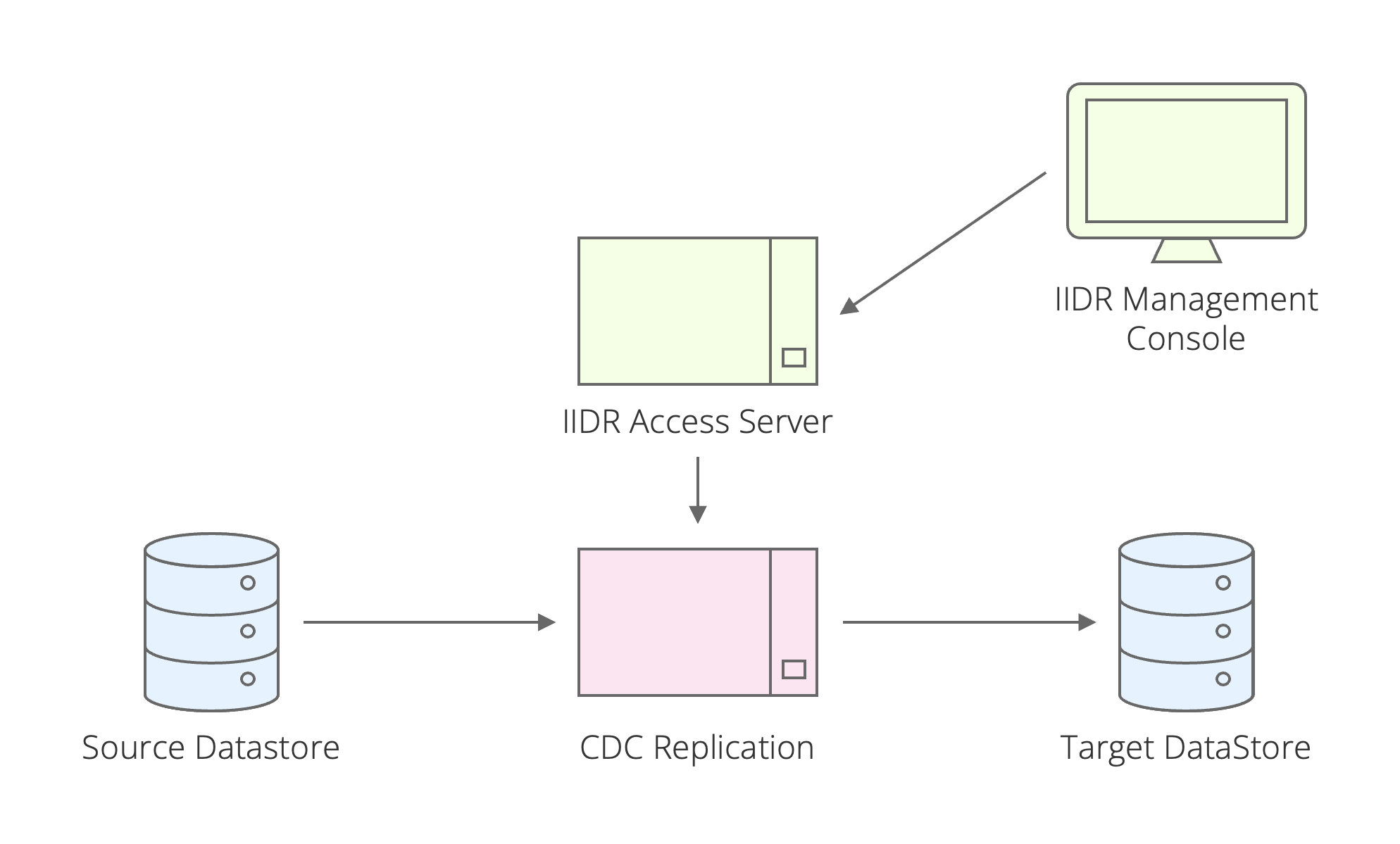
Architecture 2 is data replication from multiple sources in open systems, to multiple targets in open systems, in multi-tier architecture: two instances of the data replication engine, three source datastores, and two target datastores are on different machines.
Components [6]
The source datastores are IBM Db2 Standard databases on two virtual machines VM1 (4 cores) and VM2 (12 cores) and a Microsoft SQL Server Enterprise on a physical server PS3 (24 cores). The target datastores are Oracle Database Enterprise instances on a virtual machine VM6 (8 cores) and a physical server PS7 (12 cores). The CDC replication engines are deployed on two virtual machines VM4/VM5 each with 8 cores.
| Component | Machine | Database | Processors | No. of cores | IBM licensing |
| Source datastore 1 | Virtual machine VM1 | IBM Db2 Standard | Intel Xeon Platinum 8260 | 4 | Sub-Capacity |
| Source datastore 2 | Virtual machine VM2 | IBM Db2 Standard | Intel Xeon Platinum 8260 | 12 | Sub-Capacity |
| Source datastore 3 | Physical server PS3 | Microsoft SQL Server Enterprise | Intel Xeon Gold 6252 | 24 | Full-Capacity |
| CDC Replication engine 1 | Virtual machine VM4 | n/a | Intel Xeon Platinum 8260 | 8 | Sub-Capacity |
| CDC Replication engine 2 | Virtual machine VM5 | n/a | Intel Xeon Platinum 8260 | 8 | Sub-Capacity |
| Target datastore 1 | Virtual server VM6 | Oracle Database Enterprise | Intel Xeon Platinum 8260 | 8 | Sub-Capacity |
| Target datastore 2 | Physical server PS7 | Oracle Database Enterprise | Intel Xeon Gold 6252 | 12 | Full-Capacity |
| IIDR Access Server | Virtual machine VM8 | – | – | – | – |
| IIDR Management Console | Virtual machine VM9 | – | – | – | – |
Exhibit 11 – Components in Architecture 2
5.1. Licensing with IIDR Licenses
While using IIDR licenses (€ 114.40 per PVU J-50%), only the source datastores (VM1, VM2, PS3) and the target datastores (VM6, PS7) must be licensed. The CDC replication engines do not need to be licensed. A total of 4200 PVU IIDR licenses are required, at a cost of € 480K (J-50%).
[For clarity, values are presented with reduced decimal precision; the totals remain mathematically accurate.]
| Component | Machine | Type license | No. of cores | PVU/core | No. of PVU licenses | License unit price € per PVU (J-50%) | License costs € (J-50%) |
| Source datastore 1 | Virtual machine VM1 | IIDR (PVU) | 4 | 70 | 280 | 114 | 32,032 |
| Source datastore 2 | Virtual machine VM2 | IIDR (PVU) | 12 | 70 | 840 | 114 | 96,096 |
| Source datastore 3 | Physical server PS3 | IIDR (PVU) | 24 | 70 | 1,680 | 114 | 192,192 |
| CDC Replication engine 1 | Virtual machine VM4 | No | – | – | – | – | – |
| CDC Replication engine 2 | Virtual machine VM5 | No | – | – | – | – | – |
| Target datastore 1 | Virtual server VM6 | IIDR (PVU) | 8 | 70 | 560 | 114 | 64,064 |
| Target datastore 2 | Physical server PS7 | IIDR (PVU) | 12 | 70 | 840 | 114 | 96,096 |
| IIDR Access Server | Virtual machine VM8 | No | – | – | – | – | – |
| IIDR Management Console | Virtual machine VM9 | No | – | – | – | – | – |
| Total | 60 | 4,200 | 480,480 |
Exhibit 12 – Costs for IIDR Licenses in Architecture 2
5.2. Licensing with IDR Licenses
While using IDR licenses (€ 215.48 per PVU J-50%), only the source datastores (VM1, VM2, PS3) must be licensed. The CDC Replication Engines and the target datastores do not need to be licensed. A total of 2800 PVU IIDR licenses are required, at a cost of € 603K (J-50%).
[For clarity, values are presented with reduced decimal precision; the totals remain mathematically accurate.]
| Component | Machine | Type license | No. of cores | PVU/core | No. of PVU licenses | License unit price € per PVU (J-50%) | License costs € (J-50%) |
| Source datastore 1 | Virtual machine VM1 | IDR (PVU) | 4 | 70 | 280 | 215 | 60,334 |
| Source datastore 2 | Virtual machine VM2 | IDR (PVU) | 12 | 70 | 840 | 215 | 181,003 |
| Source datastore 3 | Physical server PS3 | IDR (PVU) | 24 | 70 | 1,680 | 215 | 362,006 |
| CDC replication engine 1 | Virtual machine VM4 | No | – | – | – | – | – |
| CDC replication engine 2 | Virtual machine VM5 | No | – | – | – | – | – |
| Target datastore 1 | Virtual server VM6 | No | – | – | – | – | – |
| Target datastore 2 | Physical server PS7 | No | – | – | – | – | – |
| IIDR Access Server | Virtual machine VM8 | No | – | – | – | – | – |
| IIDR Management Console | Virtual machine VM9 | No | – | – | – | – | – |
| Total | 40 | 2,800 | 603,344 |
Exhibit 13 – Costs for IDR Licenses in Architecture 2
5.3. Cost Optimization
Optimization of investment (license costs)
Licensing Architecture 2 with IIDR licenses is cheaper than with IDR licenses.
Indeed, IDR licenses require licensing only the sources (VM1, VM2, PS3 with 2800 PVU), while IIDR licenses require licensing both sources and targets (VM1, VM2, PS3, VM6, PS7 with 4200 PVU).
Choosing IIDR licenses in this environment increases the number of PVU licenses (4200 IIDR PVU vs. 2800 IDR PVU) but reduces costs (€ 480K vs. € 603K) since IIDR licenses are half the price of IDR licenses (€ 114.40 per PVU vs € 215.48 per PVU).
Optimization of total costs
The acquisition of licenses is classified as an investment depreciated over a three-year period at a rate of 33% per year (using straight-line depreciation).
IBM charges 20% of the license costs annually for subscription and support (maintenance). Maintenance costs are not charged in the first year, as they are included in the initial license acquisition.
The following tables show the total cost of ownership over five years for both IIDR and IDR licenses. Every value in a total row is rounded to the nearest K€.
[For clarity, values are presented with reduced decimal precision; the totals remain mathematically accurate.]
| Year | Depreciation License cost (K€) | Maintenance cost (K€) | Total cost (K€) |
| Year 1 | 160 | – | 160 |
| Year 2 | 160 | 96 | 256 |
| Year 3 | 160 | 96 | 256 |
| Year 4 | – | 96 | 96 |
| Year 5 | – | 96 | 96 |
| Total | 480 | 384 | 865 |
Exhibit 14 – Total Costs Over 5 Years for IIDR Licenses in Architecture 2
IIDR licenses require an investment of € 480K, depreciated over three years (€ 160K per year). Maintenance is included in the license acquisition in the first year. Successive maintenance, starting in year 2, is 20% of the license cost (€ 96K per year). Total costs peak in years 2 and 3 as the depreciation of the license acquisition and the maintenance are accumulated.
[For clarity, values are presented with reduced decimal precision; the totals remain mathematically accurate.]
| Year | Depreciation License cost (K€) | Maintenance cost (K€) | Total cost (K€) |
| Year 1 | 201 | – | 201 |
| Year 2 | 201 | 121 | 322 |
| Year 3 | 201 | 121 | 322 |
| Year 4 | – | 121 | 121 |
| Year 5 | – | 121 | 121 |
| Total | 603 | 483 | 1,086 |
Exhibit 15 – Total Costs Over 5 Years for IDR Licenses in Architecture 2
Now, the IDR licenses require an investment of € 603K, depreciated over three years (€ 201K per year). Maintenance is included in the license acquisition in the first year. Successive maintenance (starting in year 2) is 20% of the license cost (€ 121K per year). Total costs peak in years 2 and 3 as the depreciation of the license acquisition and the maintenance are cumulated.
6. Cost Optimization and Break-Even Analysis
6.1. Break-Even Analysis with Fixed Source Cores
As a simplified introduction to the break-even analysis, this chapter will introduce Architecture 3, a modification of Architecture 1.
Architecture 3 with fixed source cores and variable target cores
In Architecture 3, the target cores are variable, while the source cores are fixed at 12, the same value as in Architecture 1. The break-even point will be based on this architecture. The IBM core factor for Architecture 3 is assumed to be 70 PVU/core, consistent with Architecture 1.
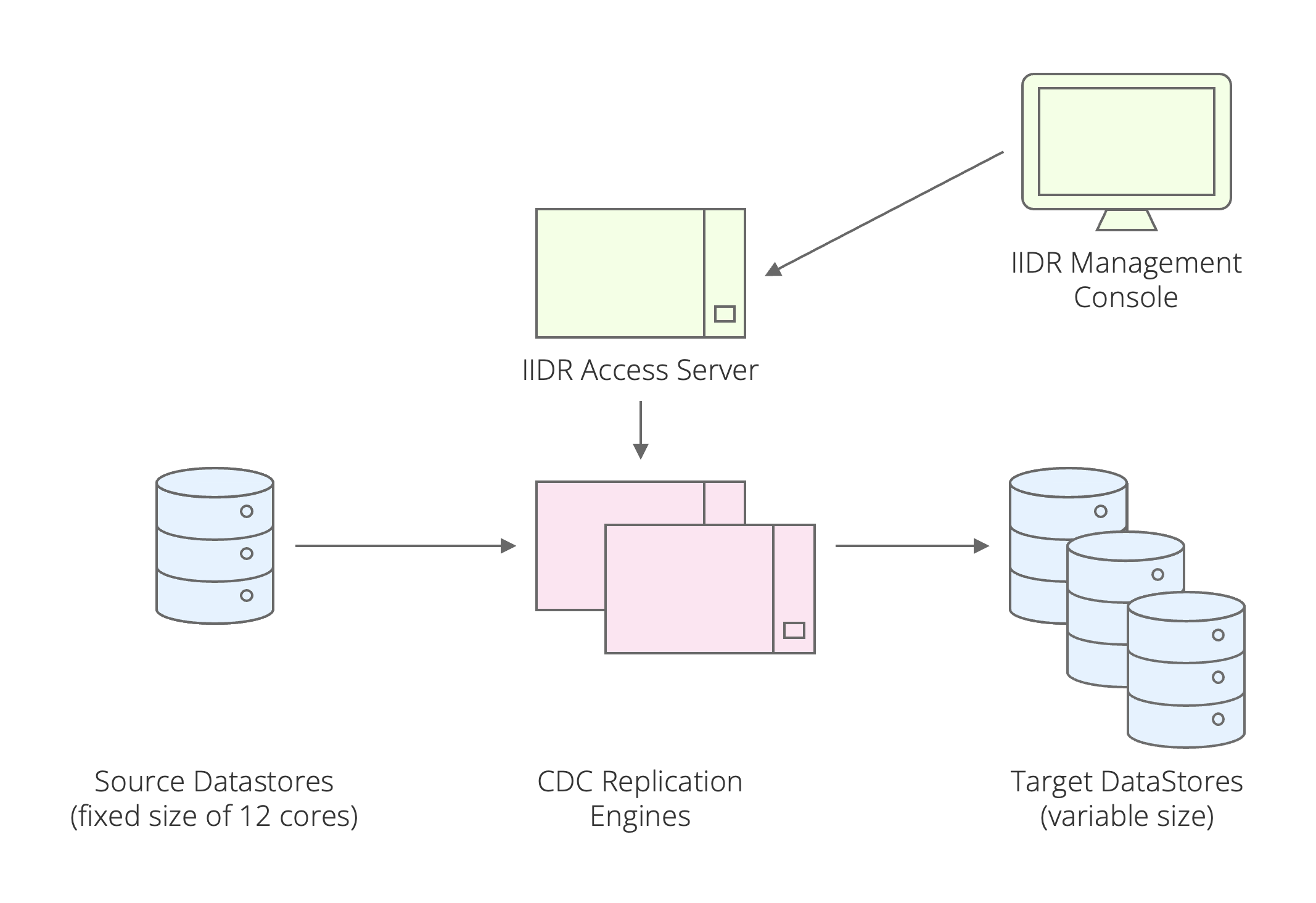
The cost of IIDR licenses is based on the size of both the source and target, whereas the cost of IDR licenses is based solely on the size of the source:
\[ \mathrm{Cost}_{\mathrm{IIDR}}= (\mathrm{Source\ cores} + \mathrm{Target\ cores}) \times (\mathrm{IBM\ core\ factor}) \times (\mathrm{Unit\ price\ IIDR}) \]
\[ \mathrm{Cost}_{\mathrm{IDR}} = (\mathrm{Source\ cores}) \times (\mathrm{IBM\ core\ factor}) \times (\mathrm{Unit\ price\ IDR}) \]
Architecture 3 translates to the following costs:
\[ \mathrm{Cost}_{\mathrm{IIDR}}\ \mathrm{in €} = \left( \mathnormal{12} \times \mathrm{Source\ cores} + \mathrm{Target\ cores} \right) \times \left( \mathnormal{70} \times \frac{\mathrm{PVU}}{\mathrm{core}} \right) \times \left( \mathnormal{114.40} \times \frac{€}{\mathrm{PVU}} \right) \]
\[ \text{Cost}_{\text{IDR}} \text{in €} = \left( 12 \times \mathrm{Source\ cores} \right) \times \left( 70 \times \frac{\mathrm{PVU}}{\mathrm{core}} \right) \times \left( 215.48 \times \frac{€}{\mathrm{PVU}} \right) \]
Simplifying, the cost is:
\[ \mathrm{Cost}_{\mathrm{IIDR}} \ \mathrm{in €}= \mathrm{8{,}008} \times \left( \mathrm{Target\ cores} \right) + \mathrm{96{,}096} \]
\[ \mathrm{Cost}_{\mathrm{IIDR}} \ \mathrm{in €}= \mathrm{8{,}008} \times \left( \mathrm{Target\ cores} \right) + \mathrm{181{,}003.2} \]
Graph and break-even
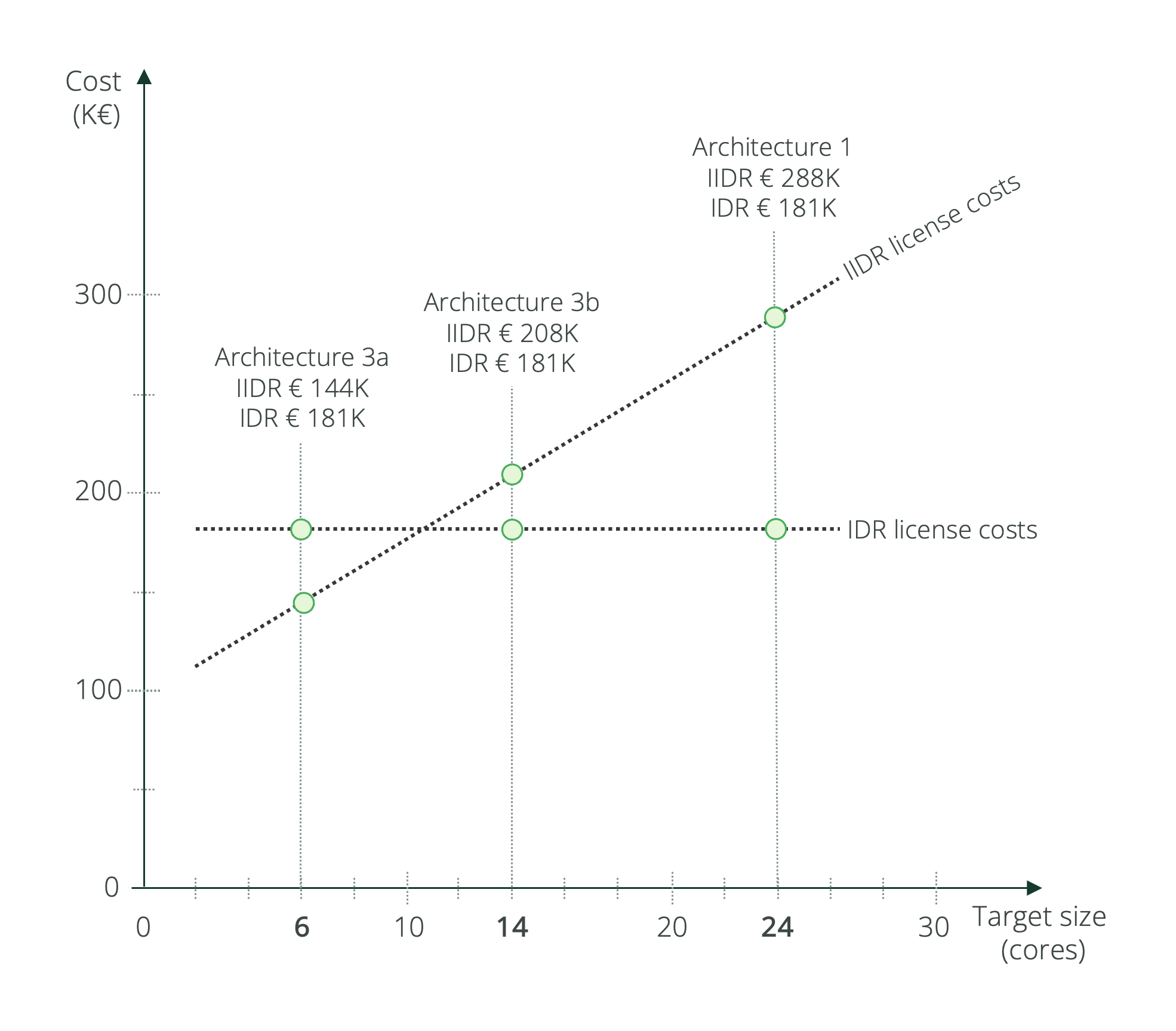
The costs of IIDR and IDR licenses can be plotted for a variable number of target cores ranging from 2 to 40 as two lines on a graph. The x-axis represents the number of target cores, and the y-axis represents the cost of the licenses.
The break-even point is the intersection of the two lines, occurring between 10 and 12 cores:
- For target sizes below 10 cores, licensing with IIDR licenses is cheaper.
- For target sizes above 12 cores, licensing with IDR licenses is cheaper.
By varying the number of target cores, different architectures can be imagined and placed on the graph: Architecture 3a with 6 target cores and Architecture 3b with 14 target cores.
- Architecture 3a, with 12 source cores and 6 target cores, is cheaper with IIDR licenses (€ 144K) and more expensive with IDR licenses (€ 181K).
- Architecture 3b, with 12 source cores and 14 target cores, is cheaper with IDR licenses (€ 181K) and more expensive with IIDR licenses (€ 208K).
Architecture 1, with 12 source cores and 24 target cores, as also shown on the graph, is cheaper with IDR licenses (€ 181K) and more expensive with IIDR licenses (€ 288K).
6.2. Break-Even Analysis with Variable Source and Target Sizes
To generalize the break-even analysis, this chapter will introduce Architecture 4, where both source and target cores are variable. The break-even point will then be determined based on this architecture.
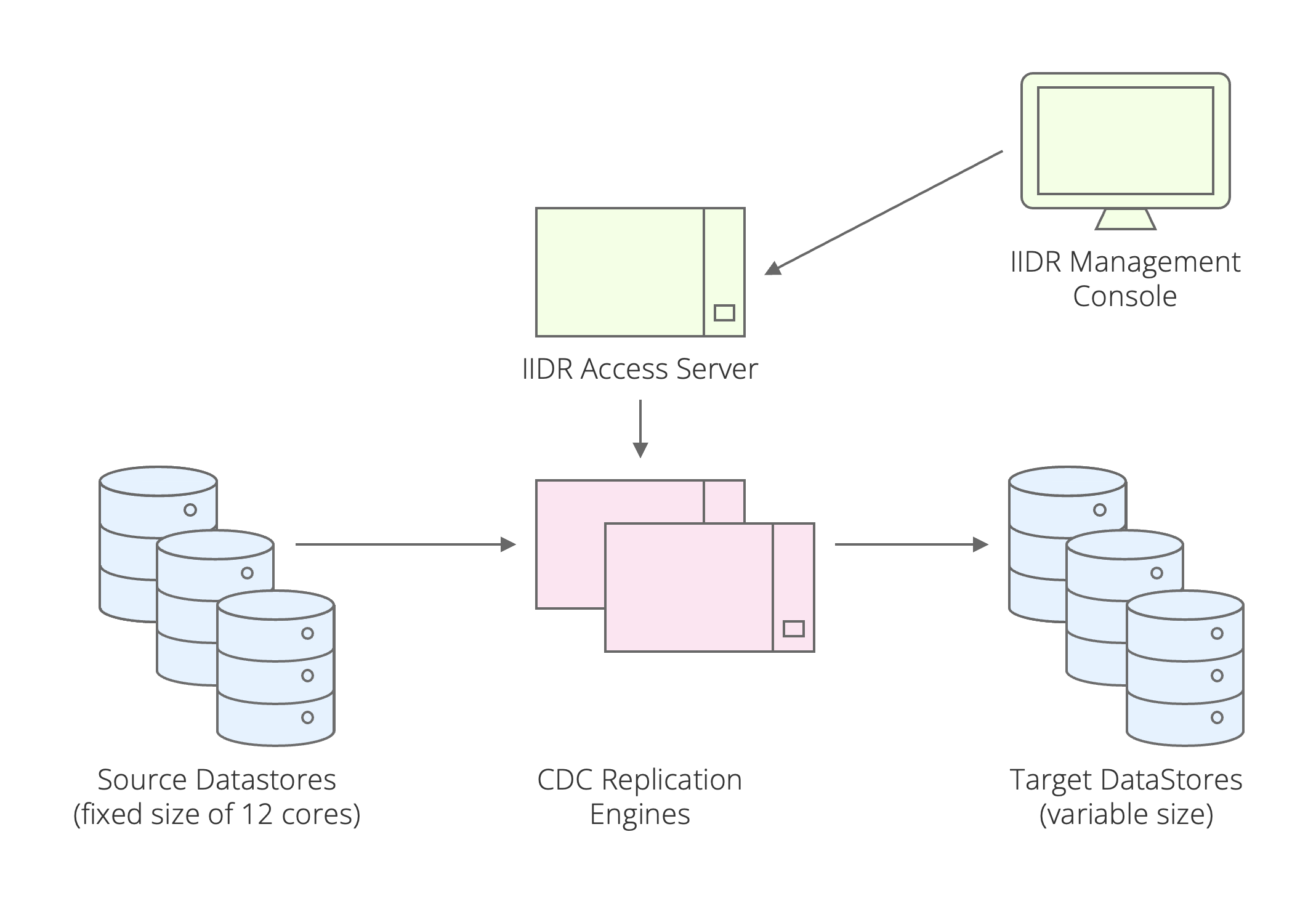
The IBM core factor for Architecture 4 is assumed to be 70 PVU/core, consistent with all architectures in this document.
The cost of IIDR licenses is based on the size of both the source and target, whereas the cost of IDR licenses is based solely on the size of the source:
\[ \mathrm{Cost}_{\mathrm{IIDR}}= (\mathrm{Source\ cores} + \mathrm{Target\ cores}) \times (\mathrm{IBM\ core\ factor}) \times (\mathrm{Unit\ price\ IIDR}) \]
\[ \mathrm{Cost}_{\mathrm{IDR}} = (\mathrm{Source\ cores}) \times (\mathrm{IBM\ core\ factor}) \times (\mathrm{Unit\ price\ IDR}) \]
Architecture 4 translates to the following costs:
\[ \mathrm{Cost} \ \mathrm{IIDR} \ \mathrm{in €} = \left( \mathrm{Source} \ \mathrm{cores} + \mathrm{Target} \ \mathrm{cores} \right) \times \left( 70 \ \frac{\mathrm{PVU}}{\mathrm{core}} \right) \times \left( 114.40 \ \frac{\mathrm{€}}{\mathrm{PVU}} \right) \]
\[ \mathrm{Cost} \ \mathrm{IDR} \ \mathrm{in €} = \left( \mathrm{Source} \ \mathrm{cores} \right) \times \left( 70 \ \frac{\mathrm{PVU}}{\mathrm{core}} \right) \times \left( 215.48 \ \frac{\mathrm{€}}{\mathrm{PVU}} \right) \]
Simplifying, the costs are:
\[ \mathrm{Cost} \ \mathrm{IIDR} \ \mathrm{in €} = 8{,}008 \times \left( \mathrm{Source} \ \mathrm{cores} + \mathrm{Target} \ \mathrm{cores} \right) \]
\[ \mathrm{Cost} \ \mathrm{IDR} \ \mathrm{in €} = 15{,}083.6 \times \left( \mathrm{Source} \ \mathrm{cores} \right) \]
\[ \text{where the costs of IIDR and IDR licenses are expressed in €} \]
Break-even
The break-even line is found by solving the equation where the cost of IIDR licenses equals the cost of IDR licenses:
\[ \text{Cost IIDR} = \text{Cost IDR} \]
Solving this equation:
\[ 8{,}008 \times \left( \mathrm{Source} \ \mathrm{cores} + \mathrm{Target} \ \mathrm{cores} \right) = 15{,}083.6 \times \left( \mathrm{Source} \ \mathrm{cores} \right) \]
\[ 8{,}008 \ \mathrm{Target} \ \mathrm{cores} = \left( 15{,}083.6 – 8{,}008 \right) \times \mathrm{Source} \ \mathrm{cores} \]
\[ \mathrm{Target} \ \mathrm{cores} \approx 0.88357 \times \mathrm{Source} \ \mathrm{cores} \]
\[ \mathrm{or} \]
\[ \mathrm{Source} \ \mathrm{cores} \approx 1.13177 \times \mathrm{Target} \ \mathrm{cores} \]
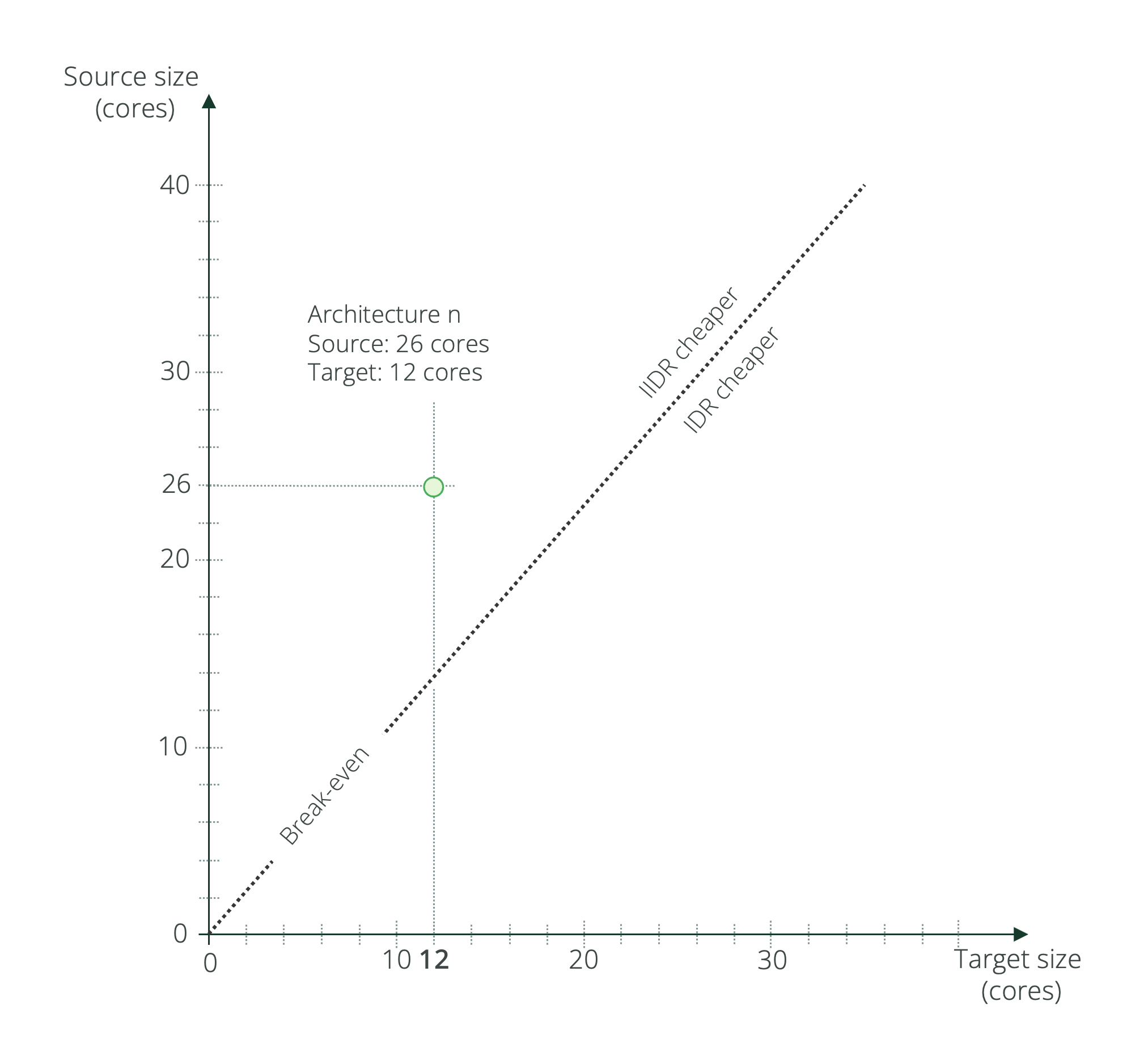
The break-even is represented by this linear function.
Either:
\[ \mathrm{Target\ cores} \geq \mathnormal{0.88357} \times \mathrm{Source\ cores} \]
Then
\[ \mathrm{Cost}_{\mathrm{IIDR}} \geq \mathrm{Cost}_{\mathrm{IDR}} \]
so IDR is cheaper, and the cost of IDR licenses is:
\[ \mathrm{Cost} \ \mathrm{IDR} \ \mathrm{in €} = 15{,}083.6 \times \left( \mathrm{Source} \ \mathrm{cores} \right) \]
Or :
\[ \mathrm{Target\ cores} \leq \mathnormal{0.88357} \times \mathrm{Source\ cores} \]
Then
\[ \mathrm{Cost}_{\mathrm{IIDR}} \leq \mathrm{Cost}_{\mathrm{IDR}} \]
so IIDR is cheaper, and the cost of IIDR licenses is:
\[ \mathrm{Cost} \ \mathrm{IIDR} \ \mathrm{in €} = 8{,}008 \times \left( \mathrm{Source} \ \mathrm{cores} + \mathrm{Target} \ \mathrm{cores} \right) \]
The break-even line is plotted on a graph for a variable number of source and target cores ranging from 2 to 40. The x-axis represents the number of target cores, and the y-axis represents the number of source cores.
Architecture 1 and 2 are placed on the graph with their respective costs of IIDR and IDR licenses.
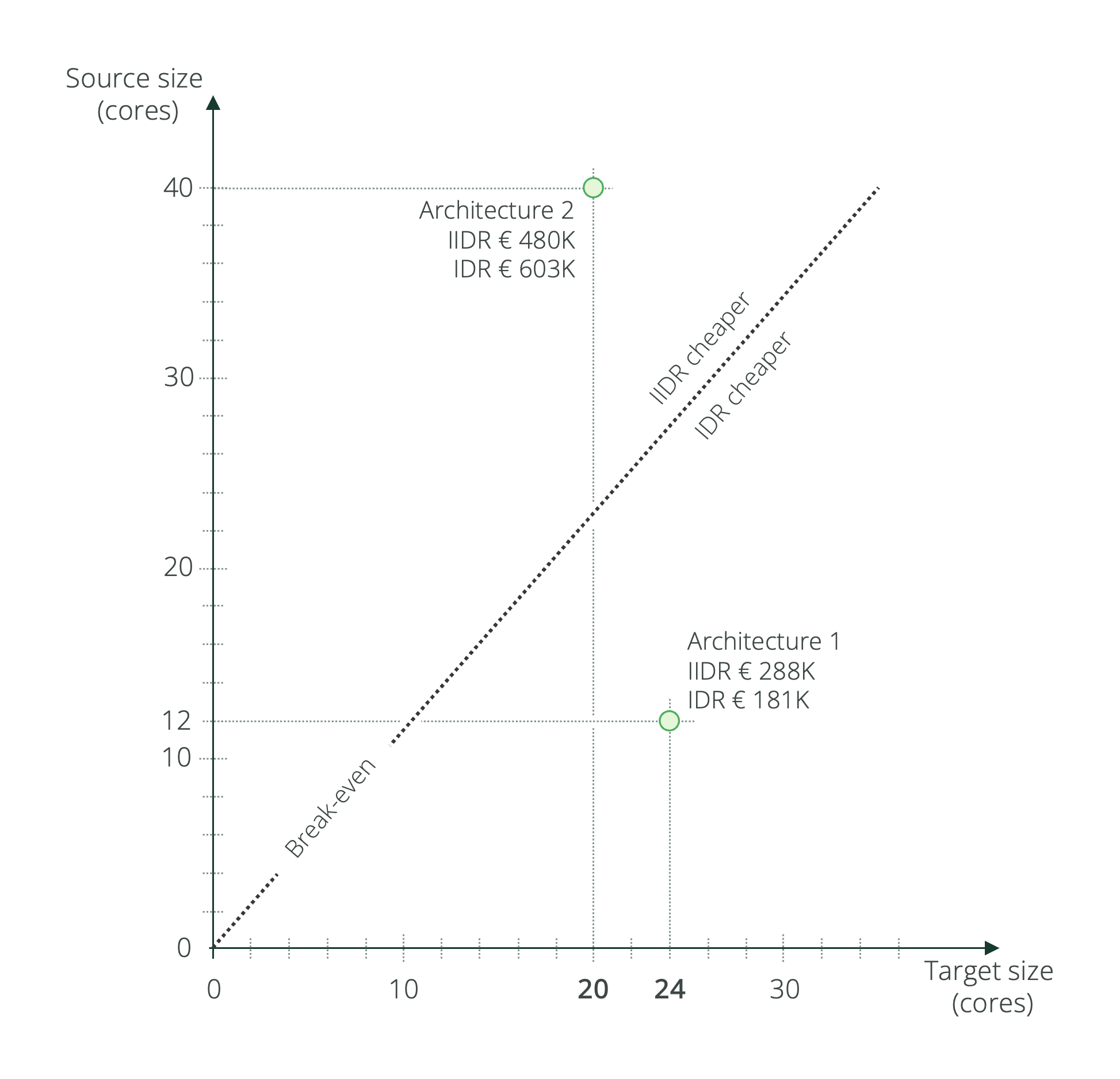
The break-even line delimits the areas where IIDR and IDR are cheaper:
- Below the break-even line (where Target cores ≥ 0.88357 * Source cores): IDR licenses are cheaper.
- Above the break-even line (where Target cores ≤ 0.88357 * Source cores): IIDR licenses are cheaper.
The graph serves as a tool for licensing managers to compare the costs of IIDR and IDR licenses based on the number of source and target cores. By visualizing the break-even line and the cost-effective areas, managers can make informed decisions to select the most cost-efficient licensing option.
6.3. Guide for Licensing Managers – Identify the Cheaper License
This guide helps licensing managers determine whether IIDR or IDR licenses are more cost-effective for a given architecture and calculate the associated costs.
By following these steps, licensing managers can accurately determine the most cost-efficient licensing option for their specific architecture. Utilizing the break-even graph and precise cost calculations ensures informed decision-making, optimizes license expenditure, and ensures compliance with IBM licensing requirements.
In addition, calculation templates are provided with the download package (refer to the file CalculationTables.xlsx, tab READ_ME, paragraph 5. Instructions to use). It allows licensing managers to generate tables for their specific architectures.
Step 1: Understand the architecture
Verify software usage – Ensure that the data replication architecture uses IBM InfoSphere Data Replication software. If not, IBM licenses are not applicable.
Check system compatibility – Confirm that the data replication architecture is on open systems (Windows, Linux, or Unix). IIDR and IDR licenses are not permitted for environments with sources or targets on z/OS.
Step 2: Technical data collection
Identify software components – Determine the software components in the architecture, including Management Console, Access Server, Data Replication Engine, and Source/Target datastores.
Collect Core Numbers – Gather the number of cores in the environments hosting the source and target datastores.
Step 3: Determine the cheaper license
Use the Break-Even Graph – Position the architecture on the break-even graph.
- If the architecture is above the break-even line, IIDR licenses are cheaper.
- If the architecture is below the break-even line, IDR licenses are cheaper.
Step 4: Calculate costs
Apply Cost Formulas – Calculate the costs for desired license using the formulas:
\[ \mathrm{Cost}_{\mathrm{IIDR}}= (\mathrm{Source\ cores} + \mathrm{Target\ cores}) \times (\mathrm{IBM\ core\ factor}) \times (\mathrm{Unit\ price\ IIDR}) \]
\[ \mathrm{Cost}_{\mathrm{IDR}} = (\mathrm{Source\ cores}) \times (\mathrm{IBM\ core\ factor}) \times (\mathrm{Unit\ price\ IDR}) \]
Step 5: Acquire licenses
Check License Availability – Verify if unused IIDR or IDR licenses are available. If not, proceed to purchase the required licenses.
6.4. Break-Even Analysis for Mathematicians
To generalize the break-even analysis, this chapter will determine the break-even points based on a generic Architecture 5, which includes multiple source and target cores.
- The source sizes, expressed in cores, are denoted as xs1, x s2 … x si … xsm for the m source datastores.
- The target sizes, expressed in cores, are denoted as xt1, x t2 … x ti … xtn for the n target datastores.
- The IBM core factor, expressed in PVU per core, may vary for each source and target. These factors are denoted as fs1, fs2 … fsi … fsm for the m source datastores, and ft1, ft2 … fti … ftn for the n target datastores.
- The license unit prices for IIDR and IDR, expressed in €/PVU, are listed in the IBM price list applicable to the organization. They are denoted as PIIDR and PIDR.
- The costs of IIDR and IDR licenses, expressed in €, are denoted as C€IIDR and C€IDR, respectively.
The cost of IIDR licenses is calculated by summing the sizes (in cores) of all source and target datastore environments, each multiplied by their respective IBM core factors (in PVU per core), and then multiplying the total by the unit price of IIDR licenses (in €/PVU). The function is linear in multiple variables:
\[ C_{\mathrm{IIDR}}^{€} = \left[ \sum_{i=1}^{m} \left( x_{s_i} \times f_{s_i} \right) + \sum_{i=1}^{n} \left( x_{t_i} \times f_{t_i} \right) \right] \times P_{\mathrm{IIDR}} \]
Similarly, the cost of IDR licenses is calculated by summing the sizes (in cores) of all source datastore environments, each multiplied by their respective IBM core factors (in PVU per core), and then multiplying the total by the unit price of IDR licenses (in €/PVU). For IDR licenses, only the sizes of the source datastores (not the targets) are considered. The function is also linear in multiple variables:
\[ C_{\mathrm{IDR}}^{€} = \left[ \sum_{i=1}^{m} \left( x_{s_i} \times f_{s_i} \right) \right] \times P_{\mathrm{IDR}} \]
Theoretical break-even
Searching for the theoretical break-even point involves solving the equation:
\[ C_{\mathrm{IIDR}}^{€} = C_{\mathrm{IDR}}^{€} \]
Hence, solving this equation:
\[ \left[ \sum_{i=1}^{m} \left( x_{s_i} \times f_{s_i} \right) + \sum_{i=1}^{n} \left( x_{t_i} \times f_{t_i} \right) \right] \times P_{\mathrm{IIDR}} = \left[ \sum_{i=1}^{m} \left( x_{s_i} \times f_{s_i} \right) \right] \times P_{\mathrm{IDR}} \]
Rearranging the terms:
\[ \left[ \sum_{i=1}^{n} \left( x_{t_i} \times f_{t_i} \right) \right] \times P_{\mathrm{IIDR}} = \left[ \sum_{i=1}^{m} \left( x_{s_i} \times f_{s_i} \right) \right] \times \left( P_{\mathrm{IDR}}\ -\ P_{\mathrm{IIDR}} \right) \]
Simplifying, the break-even is the result of the equation:
\[ \sum_{i=1}^{n} \left( x_{t_i} \times f_{t_i} \right) = \left[ \sum_{i=1}^{m} \left( x_{s_i} \times f_{s_i} \right) \right] \times \left( \frac{P_{\mathrm{IDR}}}{P_{\mathrm{IIDR}}}\ -\ 1 \right) \]
Where:
\[ \sum_{i=1}^{m} \left( x_{s_i} \times f_{s_i} \right) \quad \text{is the number of source PVUs to be licensed} \]
\[ \sum_{i=1}^{n} \left( x_{t_i} \times f_{t_i} \right) \quad \text{is the number of target PVUs to be licensed} \]
Cheaper license
To identify the cheaper license, the break-even point established previously:
If
\[ \sum_{i=1}^{n} \left( x_{t_i} \times f_{t_i} \right) \leq \left[ \sum_{i=1}^{m} \left( x_{s_i} \times f_{s_i} \right) \right] \times \left( \frac{P_{\mathrm{IDR}}}{P_{\mathrm{IIDR}}}\ -\ 1 \right) \]
then IIDR is cheaper, and the cost of IIDR licenses is:
\[ C_{\mathrm{IIDR}}^{€} = \left[ \sum_{i=1}^{m} \left( x_{s_i} \times f_{s_i} \right) + \sum_{i=1}^{n} \left( x_{t_i} \times f_{t_i} \right) \right] \times P_{\mathrm{IIDR}} \]
If
\[ \sum_{i=1}^{n} \left( x_{t_i} \times f_{t_i} \right) \geq \left[ \sum_{i=1}^{m} \left( x_{s_i} \times f_{s_i} \right) \right] \times \left( \frac{P_{\mathrm{IDR}}}{P_{\mathrm{IIDR}}}\ -\ 1 \right) \]
then IDR is cheaper, and the cost of IDR licenses is:
\[ C_{\mathrm{IDR}}^{€} = \left[ \sum_{i=1}^{m} \left( x_{s_i} \times f_{s_i} \right) \right] \times P_{\mathrm{IDR}} \]
If
\[ \sum_{i=1}^{n} \left( x_{t_i} \times f_{t_i} \right) = \left[ \sum_{i=1}^{m} \left( x_{s_i} \times f_{s_i} \right) \right] \times \left( \frac{P_{\mathrm{IDR}}}{P_{\mathrm{IIDR}}}\ -\ 1 \right) \]
then IIDR and IDR have the same costs, and that’s the breakeven point.
6.5. Conclusion
A generalized break-even analysis has been conducted using generic Architecture 5, incorporating multiple sources and targets. By defining the source and target sizes and IBM core factors, the cost functions for IIDR and IDR licenses have been derived:
\[ C_{\mathrm{IIDR}}^{€} = \left[ \sum_{i=1}^{m} \left( x_{s_i} \times f_{s_i} \right) + \sum_{i=1}^{n} \left( x_{t_i} \times f_{t_i} \right) \right] \times P_{\mathrm{IIDR}} \]
\[ C_{\mathrm{IDR}}^{€} = \left[ \sum_{i=1}^{m} \left( x_{s_i} \times f_{s_i} \right) \right] \times P_{\mathrm{IDR}} \]
The break-even point has been calculated by equating these cost functions:
\[ \left[ \sum_{i=1}^{m} \left( x_{s_i} \times f_{s_i} \right) + \sum_{i=1}^{n} \left( x_{t_i} \times f_{t_i} \right) \right] \times P_{\mathrm{IIDR}} = \left[ \sum_{i=1}^{m} \left( x_{s_i} \times f_{s_i} \right) \right] \times P_{\mathrm{IDR}} \]
Rearranging terms, the break-even point depends on the relationship between source and target PVUs, adjusted by their IBM core factors and unit prices:
\[ \sum_{i=1}^{n} \left( x_{t_i} \times f_{t_i} \right) = \left[ \sum_{i=1}^{m} \left( x_{s_i} \times f_{s_i} \right) \right] \times \left( \frac{P_{\mathrm{IDR}}}{P_{\mathrm{IIDR}}}\ -\ 1 \right) \]
The conditions for cost-effectiveness have been identified: IIDR licenses are cheaper if the weighted target PVUs are less than or equal to the adjusted source PVUs; otherwise, IDR licenses are more economical.
This framework enables licensing managers to determine the most cost-efficient option for complex architectures, optimizing licensing expenditures and ensuring IBM compliance.
7. Glossary
Break-Even Point | The point where costs for IDR and IIDR become equal. Before it, IIDR was cheaper and after it, IDR is cheaper.
Break-Even Line | The line where costs for IDR and IIDR becomes equal. Above it, IDR is cheaper, and below it IIDR is cheaper.
CDC Replication Engine | Maintaining data consistency between the source and target datastores. It captures changes from the source datastore and replicates them to the target datastore. It includes Source Capture Engine (SCE) and the Target Engine (TE). The replication from a source datastore to a target datastore ensures data availability and consistency across different systems.
IBM Data Replication (IDR) Licensing | A licensing option for IBM data replication in open systems, priced per Processor Value Unit (PVU). It is typically more expensive per unit than IIDR licenses but may require fewer licenses.
IBM InfoSphere Data Replication (IIDR) Licensing | A suite of data replication tools from IBM, including Q Replication, SQL Replication, and CDC Replication. IIDR licenses are priced per Processor Value Unit (PVU) and are cheaper than IDR licenses.
IBM InfoSphere Data Replication (IIDR) Software | A suite of data replication tools from IBM, including Q Replication, SQL Replication, and CDC Replication. IIDR licenses are priced per Processor Value Unit (PVU) and are cheaper than IDR licenses.
IBM License Metric Tool (ILMT) | A software asset management tool developed by IBM to help manage and optimize software licenses. ILMT automates the discovery and tracking of IBM software deployed in an IT environment, ensuring compliance with IBM’s licensing terms.
License Terms (Acceptance Terms) | As a key event within the framework of a Software License Agreement, the software buyer must accept the license terms and conditions: The respective approval date thereby triggers all – the start of the warranty period, the start of support, the terms of the license, and the clock on payment.
Multi-Tier Architecture | An architectural approach where different components (e.g., source datastore, replication engine, target datastore) are deployed on separate servers to enhance performance and scalability.
Processor Value Unit (PVU) | A metric used by IBM to determine the licensing cost based on the processing power of the hardware on which the software runs.
Q Replication | A type of replication method supported by IIDR that uses message queues to transfer data changes from the source to the target datastore.
Recommended Software Value Plus (RSVP) | A systematic approach or framework designed to evaluate and select software solutions that provide the highest value addition to an organization, considering multiple factors such as cost, features, performance, usability, and long-term benefits. This includes the adjusted cost of a product or service after applying specific reductions or discounts from the baseline price, used to evaluate varying costs based on contract terms or customer agreements.
SQL Replication | A type of replication method supported by IIDR that uses SQL statements to replicate data changes from the source to the target datastore.
Source Capture Engine (SCE) | The part of the CDC Replication engine that captures changes from the source datastore and pushes them to the target.
Source Datastore | The environment with the source data to be replicated – it can be a database (such as IBM Db2, Microsoft SQL Server, Oracle Database) or any application or data repository.
Sub-Capacity Licensing | A licensing approach where licenses are based on the virtual cores assigned to virtual machines rather than the full physical server capacity, applicable in virtualized environments.
Full-Capacity Licensing | A licensing approach where licenses are based on the full physical server capacity which is the total number of processor cores or the total processor capacity of the server.
Target Datastore | The environment where the replicated data is stored. It can be any database, application, or repository.
Target Engine (TE) | Part of the CDC Replication engine that receives and applies changes to the target datastore.
Virtual Machine (VM) | A software-based emulation of a physical computer, used to run applications and deploy replication components in the discussed architectures.
8. Notes
CDC Replication is issued with various database connectors depending on the databases, for instance: CDC Replication engine for Db2 for LUW, for Informix, for InfoSphere DataStage, for Microsoft SQL Server, for Oracle databases, etc. If not stated otherwise, all licensing solutions proposed in this document for CDC Replication are applicable to any CDC database connector.
The unit price RSVP (Recommended Software Value Plus) baseline, without any reductions, is sourced from an IBM public price list. The price level J has been calculated by applying an average reduction, making J equal to 89% of the baseline. All calculations in this document use a price level of J-50%. Typically, large customers experience price ranges from J-50% to J-90%, depending on their contracts. The specific price level may vary, so please consult the pricing schedule in the IBM contract.
The term “IBM InfoSphere Data Replication” (IIDR) can be confusing, as it may refer to both the deployed software components and the licenses. In this document, “IIDR software” refers to the software components deployed on servers, while “IIDR license” or “IDR license” refers to the entitlements purchased to license the data replication environment. Other terms will be understood based on the context; for example, “IIDR Management Console” and “IIDR Access Server” refer to software, whereas “IIDR licensing” or “IDR licensing” refer to the license terms.
The term “source” in the component names can be broadly interpreted to mean either the source datastore or the target datastore. The Source Capture Engine and the Target Engine are two instances of the same replication engine, each configured differently.
To calculate the number of IIDR or IDR licenses required, apply IBM licensing terms, i.e. IBM’s Processor Value Unit (PVU) metric, *not* the terms of the database vendor. If the servers hosting the source and target datastores are virtualized and eligible for Sub-Capacity licensing (e.g., on VMware or AIX), they can be licensed based on the virtual cores assigned to the virtual machines rather than the full physical server capacity. This licensing approach specifically pertains to the data replication software (IIDR or IDR) and not to the databases themselves. For example, if the target datastore is deployed on a Microsoft SQL Server database, the database is licensed according to Microsoft’s licensing rules. However, the IIDR licenses required for the data replication process on this target datastore are calculated according to IBM’s PVU metric. This distinction ensures that while the SQL Server database follows Microsoft’s licensing, the IBM data replication software adheres to IBM’s PVU licensing rules, considering any applicable Sub-Capacity provisions.
The type of repository hosting the source/target datastores is irrelevant to the licensing with IIDR/IDR licenses: it does not matter whether they are databases (Oracle Database, SQL Server…) or any data repository (file server, application). IBM licensing rules must be applied to the datastores, not the database-specific licensing. For example, when using IIDR, the target datastore on VM6 (Oracle Database) must be licensed with IIDR licenses. The PVU calculation for IIDR licenses follows IBM’s PVU counting rules (Sub-Capacity on VM), not Oracle Database’s processor counting rules (licensing on VMware Cluster/VCenter depending on the contract).
9. Sources
Download sources used in this document: https://omtco.eu/publications/how-to-license-ibm-infosphere-data-replication-cdc-replication-in-open-systems-windows-linux-unix.zip
List of provided sources:
IBM PVU Table
File: IBM_PVU_Core_Factor_Table.pdf
Reference in document: Ref. IBM PVU Core Factor Table, retrieved July 14, 2024
Date: Retrieved 14 July 2024
From: IBM
Licensing Information for IIDR
File: LI_IBM_InfoSphere_Data_Replication_V11405_LJZAXD3RX4301102023zzen.pdf
Reference in document: Ref. L-JZAX-D3RX43-01-10-2023-zz-en, IBM InfoSphere Data Replication v11.4.0.5 GA, published October 17, 2023
Date: Retrieved 14 July 2024
From: IBM
Licensing Information for IDR
File: LI_IBM_Data_Replication_V11405_LFVSXVJL8JJ01102023zzen.pdf
Reference in document: Ref. L-FVSX-VJL8JJ-01-10-2023-zz-en, LI IDR v11.4.0.5 GA, published October 17, 2023
Date: Retrieved 14 July 2024
From: IBM
Calculation Tables
File: CalculationTables_19July2024.xlsx
Reference in document: All tables referenced in the document
Date: Saved 19 July 2024
From: Calculations by Omtco
High Resolution Images (Exhibits)
Folder: high_resolution_images
Reference in document: All exhibits with images
Date: Saved 19 July 2024
From: Generated by Omtco
10. Index of Exhibits
Exhibit 1 – Functional Data Replication
Exhibit 2 – Unit Price of Licenses for All Environments
Exhibit 3 – Unit Price of Non-Production Licenses
Exhibit 4 – One-to-One Data Replication (Architecture 1)
Exhibit 5 – Components in Architecture 1
Exhibit 6 – Costs for IIDR Licenses in Architecture 1
Exhibit 7 – Costs for IDR Licenses in Architecture 1
Exhibit 8 – Total Cost Over 5 Years for IIDR Licenses in Architecture 1
Exhibit 9 – Total Cost Over 5 Years for IDR Licenses in Architecture 1
Exhibit 10 – Multiple-to-Multiple Data Replication (Architecture 2)
Exhibit 11 – Components in Architecture 2
Exhibit 12 – Costs for IIDR Licenses in Architecture 2
Exhibit 13 – Costs for IDR Licenses in Architecture 2
Exhibit 14 – Total Costs Over 5 Years for IIDR Licenses in Architecture 2
Exhibit 15 – Total Costs Over 5 Years for IDR Licenses in Architecture 2
Exhibit 16 – Data Replication with Fixed Source Cores (Architecture 3)
Exhibit 17 – License Cost Dependency when Source Size is Fixed
Exhibit 18 – Data Replication with Variable Source (Architecture 4)
Exhibit 20 – Determination of the Cheaper License
11. Trademarks
The following terms are trademarks.
IBM InfoSphere Data Replication, IBM Data Replication, and IBM DB2 are registered trademarks of IBM International Business Machines Corp., in the United States and other countries.
Microsoft Windows Server, Microsoft Windows and Microsoft SQL Server are trademarks of Microsoft Corporation in the United States and other countries.
Oracle Database is a trademark of Oracle Corporation in the United States and other countries.
Intel Xeon is a trademark of Intel Corporation in the United States and other countries.
VMware is a registered trademark of VMware, Inc. in the United States and other countries.
AIX is a trademark of IBM Corp., in the United States and other countries.
Linux is a registered trademark of Linus Torvalds in the United States and other countries.
Unix is a registered trademark of The Open Group in the United States and other countries.
Other company, product, or service names may be trademarks or service marks of others, in the United States and other countries.
12. Authors and Notices
Authors
 |  |
| Uttam PANDA Consultant, Munich office Email: uttam.panda@omtco.eu | Louis VALLIEZ Consultant, Paris office Email: louis.valliez@omtco.eu |
About OMTCO
OMTCO specializes in Software Asset Management (SAM), licensing expertise, compliance audits, and SAM tools, helping organizations manage software assets, optimize costs, and ensure licensing compliance with major vendors like Oracle, IBM, and Microsoft. OMTCO is independent from any software vendor. For tailored advice, contact OMTCO at office@omtco.eu. Additional publications and resources are available at https://omtco.eu.
Statement of Independence
OMTCO is fully independent of any software vendor, including Microsoft, Oracle, and IBM, as well as any external interests. OMTCO does not sell licenses, maintenance, or support contracts from any third party, nor does it work for any software vendor. Professional and respectful relationships with software vendors are maintained solely for the benefit of clients. As a 100% employee-owned company, OMTCO does not rely on external interests and holds no stakes in any external company or interest. OMTCO’s Statement of Independence is available at: https://omtco.eu/documents/StatementOfIndependence.
Confidentiality notice
OMTCO ensures strict confidentiality, safeguarding client names, projects, and data. This document is based on public information, OMTCO’s knowledge database, and internal analyses. For more details on our confidentiality practices, please contact an OMTCO representative.
Disclaimer
This document is current as of its initial publication date and may be updated by OMTCO at any time. Not all offerings are available in every country where OMTCO operates. The information in this document is provided “as is” without any warranty, express or implied, including, but not limited to, warranties of merchantability, fitness for a particular purpose, and non-infringement. This report is for informational and illustrative purposes only and does not consider your specific situation. Refer to the disclaimer at https://omtco.eu/disclaimer.
[END OF DOCUMENT]